

Poster Presentation: High Throughput RNA Synthesis Using 2’-O-Acetal Levulinyl Esters (ALE) Phosphophoramidites
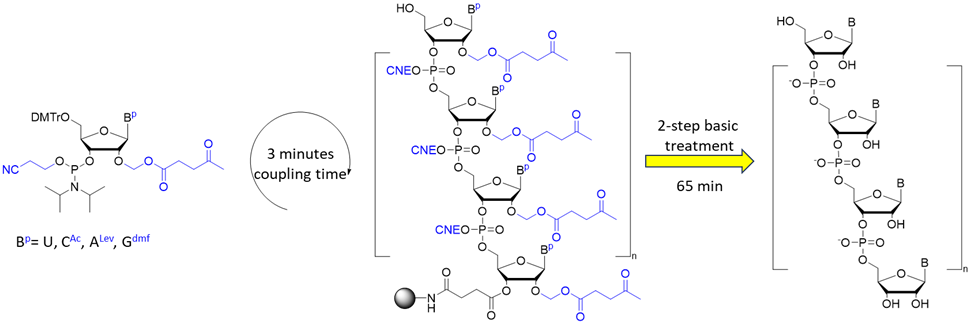
With the emergence the last decade of novel powerful gene editing tools such as CRISPR-Cas9 and ADAR, the need for synthetic guide RNAs (gRNAs) keeps increasing. To date, gRNAs are essentially synthesized using the 2’-O-TBDMS approach. However, this technology suffers from a long 10-minute coupling time, occupying the synthesizer for long periods and lowering productivity concomitantly to the length of the gRNA. In addition to the standard basic deprotection, the TBDMS has to be removed by hazardous fluorinated reagents.
Besides a shorter coupling time, the superiority of the ALE technology resides in its expeditive 1hour 2-step basic deprotection protocol. With the goal of optimizing the overall time dedicated to the production and deprotection of RNAs, we have revisited this procedure and reduced it to 4 short steps without any evaporation, in order to make RNA synthesis as convenient as DNA synthesis.